Tony
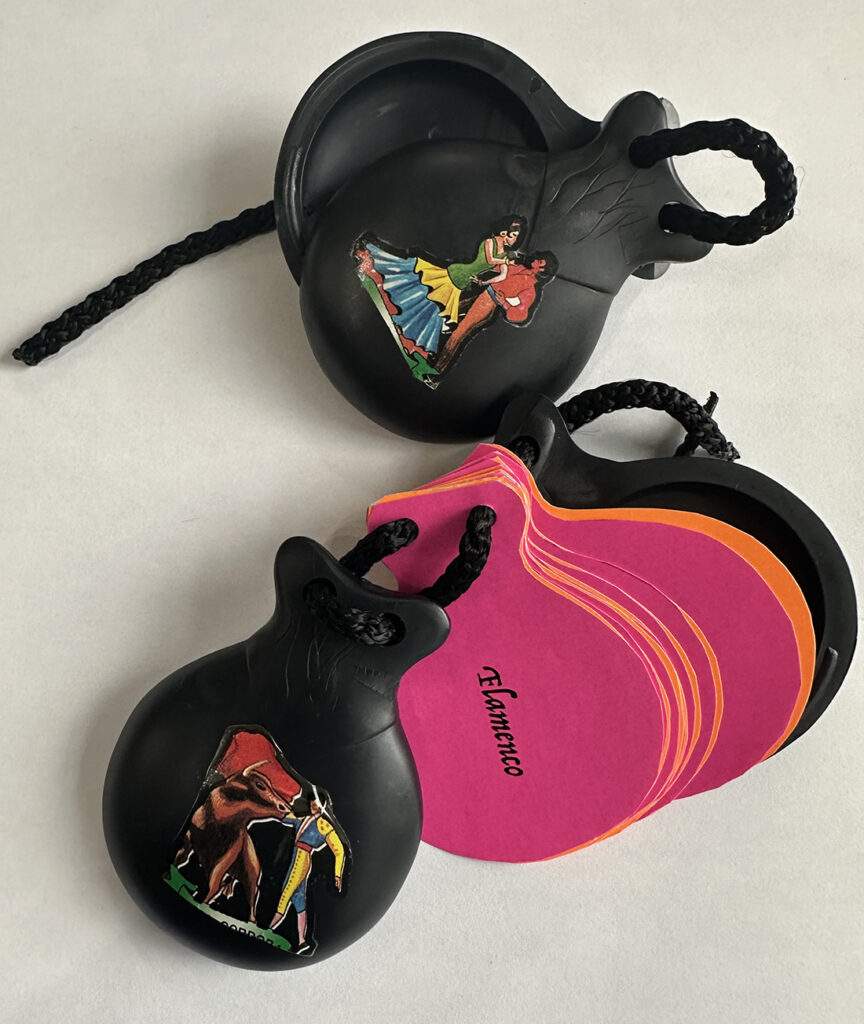
I stumbled at the first hurdle with my book for Tango as I confused it with Flamenco. My poor excuse is I saw them performed in Buenos Aries and Madrid respectively but a long time ago. I was disappointed as I really wanted to use castanets for my book cover. To shoehorn this idea into the theme I decided to compare Tango with Flamenco in a fun, simplistic way.
Here are my feelings on the differences between the dances. Hopefully I don’t offend any aficionados of either dance.
| Tango | |
| Sleek Sharp Domination | Aggressive Dangerous Male |
| Flamenco | |
| Frenetic Flamboyant Musical | Exaggerated Flounces Female |
Dawn
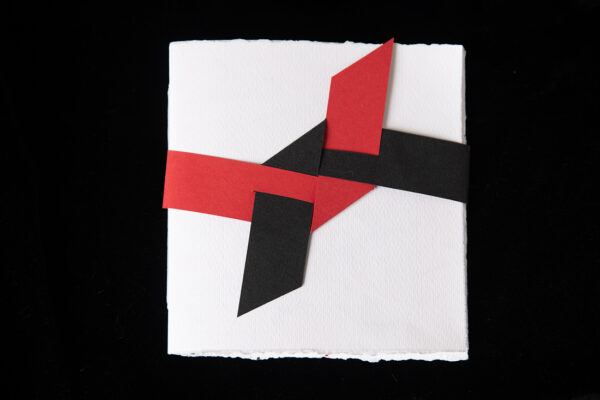
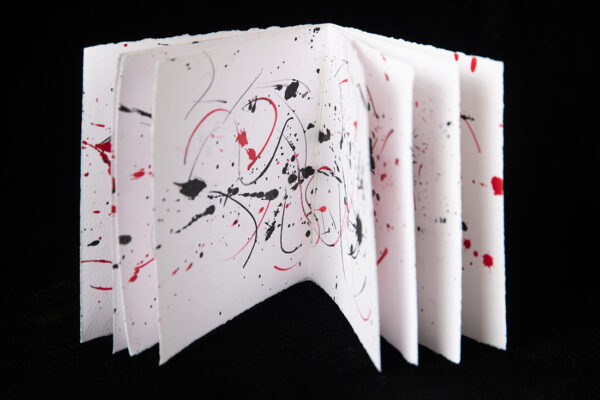
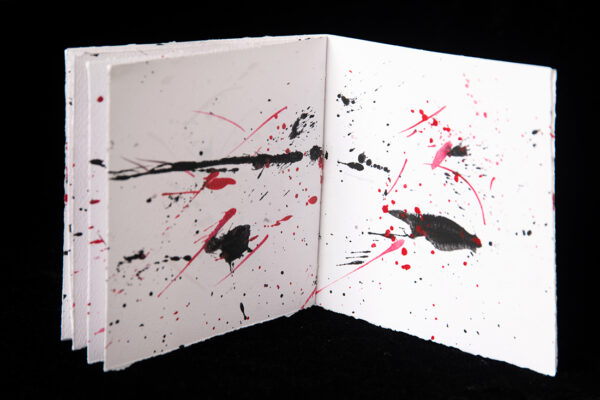
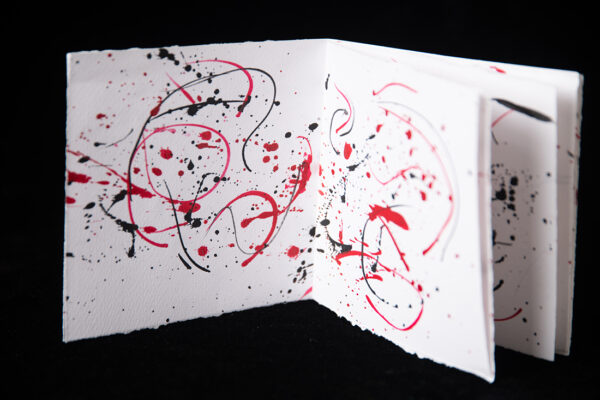
This small pamphlet book is an attempt to capture the essence of the Argentine tango, soft and sharp at the same time. Sweeping black lines curl and snap back on themselves; crimson arcs cut through with more urgency; a fine spray of ink spatter scatters like percussion. The marks are as much gesture as image, the flick of a leg, the pivot of a turn, the sudden stop and held breath before the next phrase. Black and red against raw white paper is the tango’s own colour narrative: control and heat, restraint and abandon, sitting in the same frame. The mark-making shifts between the dance’s discipline and its reckless, improvisational moments — a visual attempt to catch not just its shape, but its rhythm.
Gill
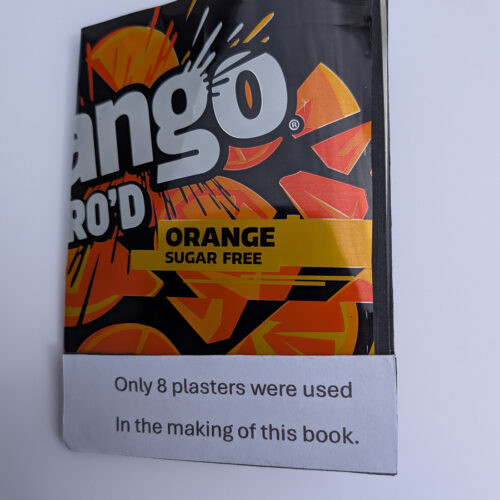
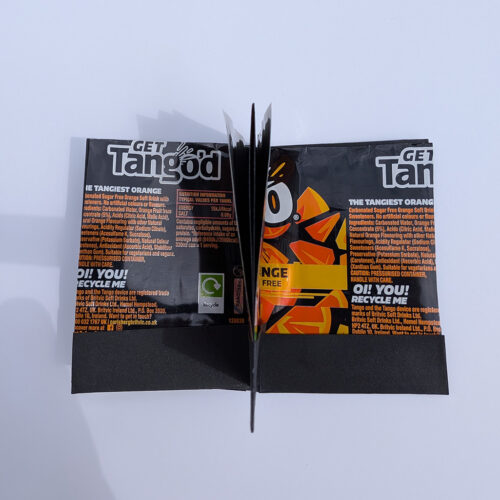
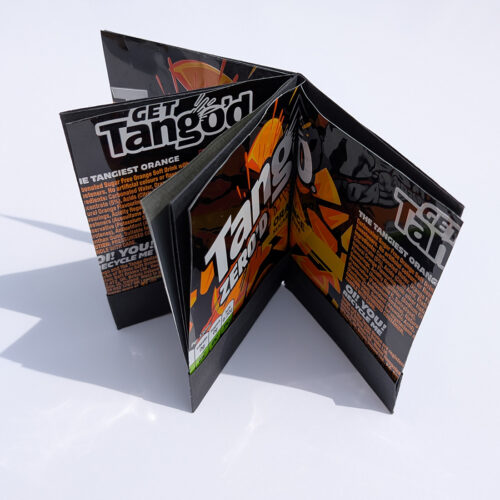
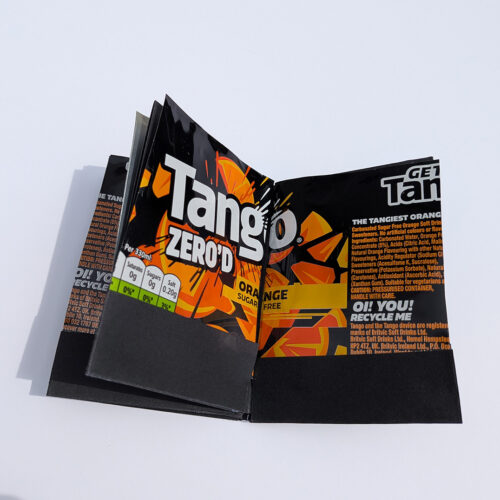
As I have an interest in making books from materials that are not necessarily paper, I decided to make my book from cut up Tango drinks cans. It wasn’t easy to manipulate the metal and to make it lie flat, and I included a health warning. The structure is a simple A4 piece of black paper….. A folded book with pockets.
Joan
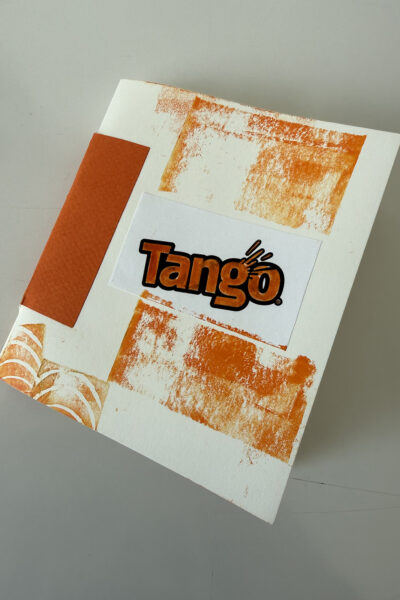
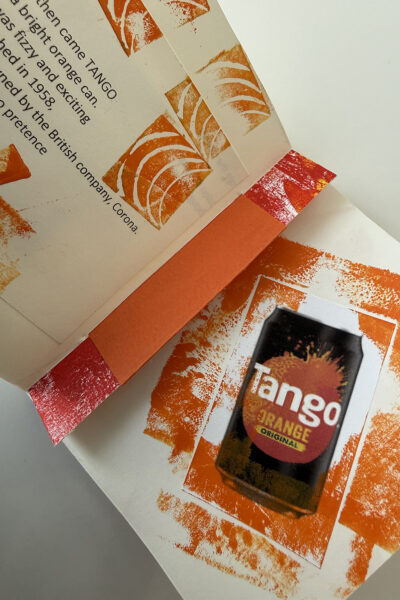
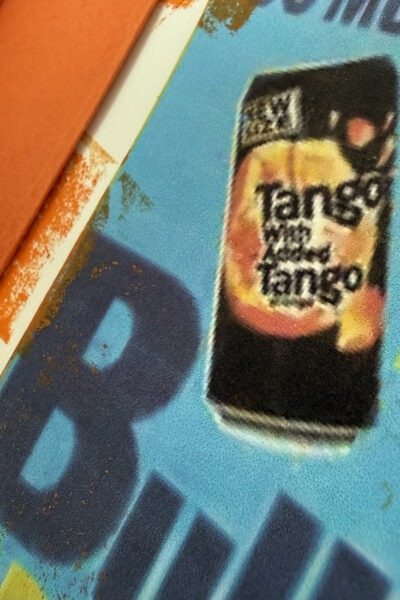
My book for the LAB meeting in August was about the soft drinks industry and how things have changed since the 1950s.
As a child I remember the ‘pop man’ coming round with his horse and cart, delivering Ben Shaw’s ‘pop’. It came in heavy glass bottles and our favourites were Dandelion and Burdock and Cream Soda. Later, we drank Kia Ora in the cinema in Huddersfield and then along came ‘Tango’, an altogether different drink, with its risqué adverts and sense of fun.
This is a ‘tab book’, with collage and print.
Patti
This book explores the language of tango as a metaphor for a relationship: contact and connection, waiting and following, silence and absence, adapting to another person’s rhythm, and the shifting balance between holding, direction and control. Short, emotionally charged texts are paired with diagrams and imagery derived from tango steps and gestures, creating a tension between the apparent precision of dance and the ambiguity of the relationship.
The book’s structure is one of the trickiest I’ve ever made, not because of the structure (based on a Jacob’s Ladder), but the difficulty in getting the text and images in the correct place. It reinforces the content through its structure, which makes the pages interact with one another rather than simply being read as a linear sequence.